Whose Fault Is This
Everything in this book has one source, and that source has a name. A story in which the hero and the culprit are the same person.
Läuft gerade
Whose Fault Is This
Kapitel 1 von 8 · Whose Fault Is This
Wird geladen…
Kapitel (8)
Das ganze Kapitel zum Lesen
I have to say something that should have been said a long time ago. Not at the end, not in a footnote, not between the lines. At the beginning, out loud, by name.
Everything I describe in this book, every roof, every clip round the ear replaced by nothing at all, every thirty-year-old living at his mother's, every mother crying in the bathroom at eleven at night because she doesn't know what she's doing wrong even though she's doing everything, has one source.
And that source has a name.
Benjamin Spock.
Hold on. Not so fast. Because this is a story in which the hero and the culprit are the same person, and it has to be told honestly for you to understand how we got here.
Who Was Doctor Spock
Born 1903, died 1998. A paediatrician, and not just any paediatrician. The first paediatrician in history to train in psychoanalysis. He combined knowledge of a child's body with knowledge of a child's mind at a time when nobody else was doing it.
In 1946 he published a book that changed the world. Literally, changed the world. The Common Sense Book of Baby and Child Care sold more than fifty million copies. Through the second half of the twentieth century it was the second best-selling book in the United States.
The first was the Bible.
And one more thing, because it matters: how I came across him at all. I asked two questions. Which parenting book is the most popular in the world. And which one sold best. It turned out that the one that sold best is also the most popular one.
To understand why that book landed so hard, you have to understand what happened on this planet twenty years earlier.
The Experiment Nobody Planned
I have been saying this for two decades and I'll say it here, because it is the foundation.
Hominid mammals are unique on this planet. They are the only ones to have gone through an experiment so extreme that no scientist would have dared to design it.
And they went through it twice, within a single lifetime.
The experiment is called the First World War and the Second World War.
Enormous numbers of males were taken away from the females. Millions of men walked out of their homes and never came back. In any animal world that is a break in the balance after which the herd falls apart. Structure disappears, roles blur, survival demands of the females things they have never done before.
And the females had to adapt. They had to, and that was that. Sink or swim.
They ran farms, factories, families, on their own, with no instructions, no internet, no mobile phone, no car at all, without absolutely anything we consider basic equipment for living today.
It is 1946. The war ended last year. Whoever came back, came back. The rest are never coming back. There is no YouTube, no Netflix, no online guides, no support groups on Facebook. There is nothing. And you are a mother, no matter whether your husband came back or not, because the times are nothing like anything that used to pass for the way things always were.
And then Doctor Spock appears.
What Doctor Spock Did, and Why He Was a Hero
This man saw things we cannot imagine. He saw mothers who didn't sleep. Mothers who didn't eat. Mothers who hit their children because they had been hit themselves and knew no other way. He saw an entire generation of women who had survived a war and were now trying to raise children in a world whose rules had just changed, with no guide at all.
And he wrote that guide.
The first sentences of his book were: "Trust yourself. You know more than you think you do."
Two sentences. And those two sentences did more for millions of mothers than all the medicine of the time put together. Because in 1946 mothers were hearing one thing: listen to the expert, because you know nothing yourself. Doctor Spock said the opposite. Trust yourself. Your instincts are good. You don't have to be afraid of your own child.
Before that, the norm was feeding an infant strictly every four hours, regardless of whether it was crying from hunger. Doctor Spock said: feed it when it's hungry. Before that, a baby was supposed to lie in its cot and you were not allowed to pick it up, because it will get used to it. Doctor Spock said: pick it up. Hold it. Love it.
For fifty-two years, from 1946 to 1998, when he died, he brought out new editions, updated them, corrected them. He protested against the war in Vietnam. He fought for parents' rights. He stood on the side of children when nobody else did. For half a century he stood between mothers and the world and said: you can do this.
And he was right. For those times, absolutely right.
The Problem Is That Those Times Are Over
Doctor Spock died in 1998. Seven years before YouTube. Nine before the iPhone. Fifteen before a three-year-old started operating a tablet better than his grandmother.
He died at the moment when the world he had written his book for was just ceasing to exist.
And that is the whole problem. Because what we call stress-free parenting today has almost nothing to do with Doctor Spock. Doctor Spock never said: don't set boundaries. He never said: let the child do whatever it wants. He never said: don't say no.
But his revolution, trust yourself, love your child, don't be a tyrant, landed in soil that over the following decades produced a harvest nobody planned.
And now the question that changes this whole story:
What exactly are you supposed to trust?
Instinct exists. It really does exist. The one that wakes you at night when the little one is breathing heavier than usual. The one that tells you something is wrong long before any symptom appears. The one that, in real danger, doesn't ask your opinion and simply acts. That instinct works. It worked in 1946 and it works today.
But in 1946 a woman's life held maybe ten strong stimuli a day. Today there are a thousand. Notifications. Comparisons. Opinions. Fifty articles about what you're doing wrong. A WhatsApp group where another mother has just posted a photo of the perfect dinner. Exhaustion that hasn't let up in three years.
And now try to hear instinct in that noise.
You won't. You'll hear emotion. Fear, guilt, anger, anxiety, and you'll mistake it for instinct, because both of them speak from the gut.
Instinct is that quiet, certain signal that says something is wrong, and it is right. Emotion is that loud, hot signal that says everything is wrong, and it is right about how you feel, but not about how things are. Why emotions can take the wheel and what to do about it, there is a whole chapter about that in this book, Coach versus Parent. And not without reason.
When Doctor Spock said trust yourself, he was speaking to women who lived in a world quiet enough to hear that signal. Today, trying to tell instinct from emotion day after day is doomed to fail. Not because instinct disappeared. Because it is drowned out.
Trust yourself, as the only piece of advice, is not enough. You also have to know what you are trusting, that quiet signal from underneath, or that loud scream on top.
Because the pendulum swung.
How the Pendulum Swung to the Other Side
It didn't happen overnight. It took generations and it had its reasons, good reasons, every one of them.
Equal rights. Women started doing what men did, and many times they did it better. They took over roles that used to be reserved for the males in the herd. They became strong, independent, self-sufficient. And that is good, and that is progress.
But that is exactly how the thing I write about in this book came to be. Women learned to go solo. Not because they have to, because they can. The generation of their mothers and grandmothers learned the hard way that you cannot count on a man. And that lesson carried on.
Women are tough as nails now. They don't need guides telling them to trust themselves. They do trust themselves. They know they will manage, because they have been managing for three generations.
Except the world changed along the way.
My dad once got hit with a ruler by his teacher. If he had gone to his own father about it, he would have got the belt even harder. It was extremely different. Too harsh, too hard, too much.
And now? Now a teacher winks, a pupil calls it aggression, and the teacher gets suspended.
The world flipped. From one extreme to the other.
And in that inverted world, a guide that says love your child and trust yourself stopped being the medicine. It became the disease.
In a world where the father swung the belt, somebody had to say: don't hit, love, trust.
In a world where nobody sets any boundary at all, somebody has to say something completely different.
The Bill
I want you to see this bill. All of it, out loud, because nobody is issuing it.
Three generations of interpretations, distortions and simplifications after Doctor Spock. And here is what we have.
For the fact that you can't find an employee. Young people come onto the job market and the first difficulty stops them, not because they are stupid, but because nobody ever let them lift anything heavy. Nobody made them stick with something. Nobody let them face the consequences. We raised a generation that can say anything and do nothing.
For the fact that mothers are wasting their parenthood. Out of love. With the best intentions. They do for their children everything those children could do themselves, and they create growing problems instead of growing people. Eighteen years running around them like personal room service, and then crying that a thirty-year-old can't cook himself a dinner.
For the fact that so many potential men never got the chance to become men. They stayed boys forever. They live at their mother's, because that suits them best. Nobody ever showed them there was anything else.
For the fact that mothers have to torture themselves emotionally through the whole of their parenthood. Get upset over nothing. Burn out. Cry in the bathroom. And for the fact that they often end up not liking their own child, instead of having a home in growing balance and constant improvement.
For the fact that so many women today cannot find themselves a man. Because there are fewer and fewer men, or rather, more and more boys.
A thirty-year-old guy who can't phone the doctor's surgery is not a partner. He's a third child.
And one more number, briefly, because it says everything. Since the Doctor's day there are five times as many divorces in Poland, and half as many weddings.
None of this is Doctor Spock's fault. It's the fault of what we did with his legacy.
Farewell to the Doctor
Doctor Benjamin Spock.
You are a legend. Not ironically, not rhetorically, a legend. You helped millions of women at a moment when nobody else was helping them. You gave them something they did not have: permission to be a good mother in their own way.
It's a shame we never got to meet. I'm curious what you would say, because you died before the world you were writing for turned upside down. Before smartphones, before TikTok, before a world in which a three-year-old is more overstimulated than a grown soldier at the front.
You got to leave believing it had gone well. Maybe even better and better, because in your day every step towards gentleness was a good step. You had no idea what would grow from what you planted.
Until the last second of your life, parenting was never stress-free. Certainly not in Poland, but having lived seventeen years in the United Kingdom I met people of more than a dozen nationalities and every one of them talks about a clip round the ear, only in a different language. Every one. Everywhere in the world.
You helped parents in the second half of the twentieth century. You did what was needed, when it was needed.
And now I have to apologise to you.
When I found out which parenting book had sold best and been the most popular in the world, it turned out to be yours. I had never known it. All I asked was whether you could say it had something to do with stress-free parenting. I was told you could.
And on that basis I insulted you. I thought: idiot. Wrote the stupidest book ever written.
I had no idea what you had written. I didn't know who you were writing for, or what world you were writing in. But I gave my opinion anyway.
It was only when I sat down and read what you had actually done that I realised I had broken the one rule this whole book stands on.
If you haven't had it, you can't speak. If you don't know, you can't speak.
I'm sorry, Doctor. It proved itself on me.
Allow me to take the twenty-first.
We no longer need to teach mothers to trust themselves. They do trust themselves. We need to learn something else: how to be a parent in a world where the sheer volume of stimulation is so enormous that adults cannot cope. And then get angry at children for blowing their fuses.
One more thing. It changed its meaning along the way.
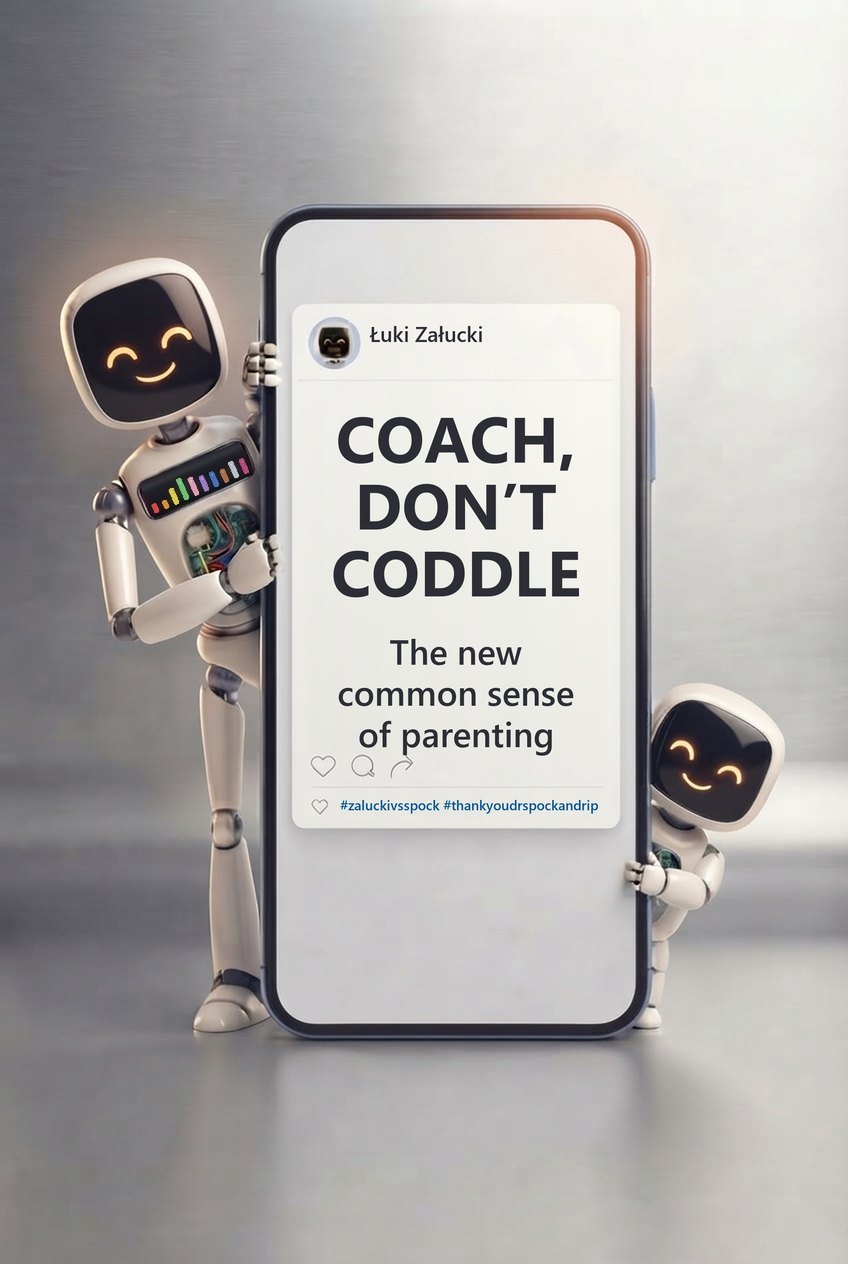
When I started this book, I came up with two hashtags: zalucki versus Spock, and thank you doctor Spock and rest in peace.
The first one came about when I was certain you were my opponent.
I finished the way you have just read. So, to be clear: that versus does not mean enemy. It means comparison. Your half century and mine, side by side.
Thank you, Doctor.
Now it's my turn.